Understanding Perception
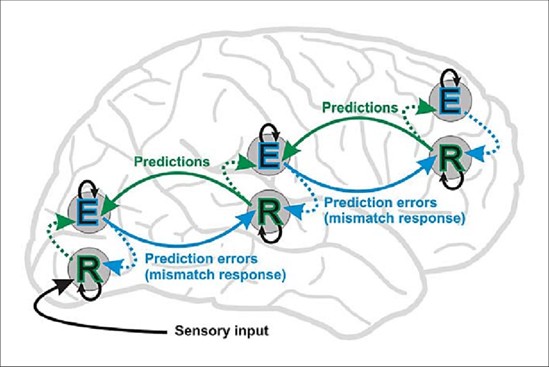
In 2015, the dress illusion was viral on social media with viewers disagreeing on whether the dress was blue and black or white and gold. The neuroscientist and psychologist Pascal Wallisch pointed out that perceptions differed in response to changes in illumination and fabric. The way people see the dress is closely linked to how their brains handle colour constancy—a process that helps us see colours consistently under different lighting. This means the way people see the dress isn’t random, but part of a consistent way their brain works. Conventionally, perception is viewed as the ability to detect external stimuli by our sensory organs and then send this incoming data upward to the brain for processing.

The brain is a prediction machine
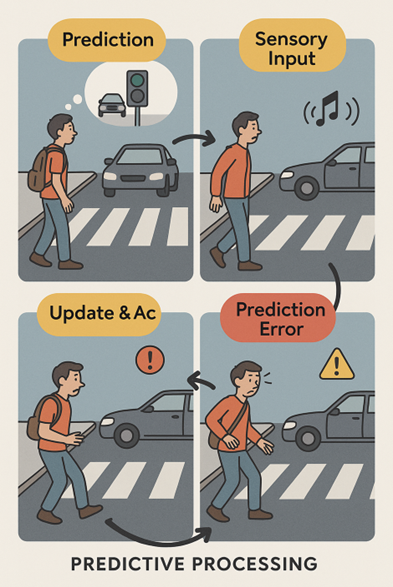
Before crossing a busy road, your brain continuously prepares itself for how to cross the street. This involves steps such as receiving visual and auditory sensory input in the form of traffic signals, signs, boards, approaching vehicles, honking, and the sound of accelerating engines. The brain then compares these sensory inputs with previous experiences, makes predictions based on reality, and improvises based on the situation—resulting in safe action.
Real-world implications
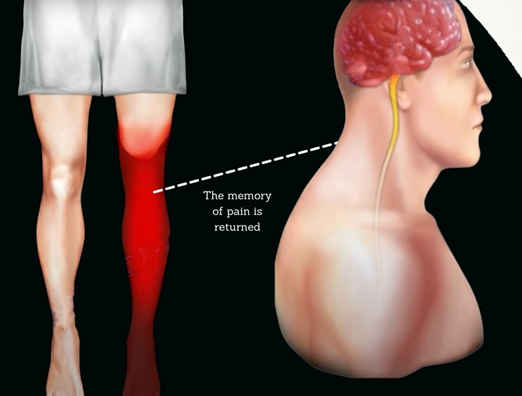
When a person undergoes amputation of a limb, the brain’s internal model does not update instantly after the loss as it is built from a lifetime of previous sensory and motor experiences. This causes a prediction mismatch as no sensory feedback is received from the limb and the brain interprets this mismatch as something missing and unusual. Thus, even though the limb is amputated, it may result in pain where the limb used to be. Treatments such as mirror therapy help trick the brain and potentially correct the prediction error.
Predictive processing and mental disorders
Most research on mental disorders has looked at how people automatically react to emotional cues and how this affects their thinking. In individuals with anxiety and chronic stress, the brain constantly predicts danger and threat, even when situations seem safe. Similarly, those suffering from depression develop a habit of predicting negative outcomes and tend to struggle with imagining a positive possibility. Excessive prediction processing by the brain results in repetitive, intrusive thoughts and behaviours and a need to control unpredictable outcomes. Constantly predicting negative outcomes can cause misinterpretation of neutral actions as threats and fuel further negativity.
In schizophrenic individuals, perception is distorted by hallucinations (false perceptions) and delusions. In schizophrenia, predictions may be too weak or unreliable, so the brain fails to use past knowledge to interpret current input. Since the brain can’t properly resolve prediction errors, imagined sounds or visions become real. This can contribute to cognitive difficulties and emotional dysregulation. There is a failure of internal models of motor control which leads to difficulty in sensory data.
Predictive processing and AI
The predictive processing model is also used widely in Artificial Intelligence, as models are created through abstract predictions. It offers framework for developing advanced AI, inspired by how children learn through interaction. In chatbots or customer service dialogue partners, after interpretation of the input, data is then converted into numerical representations which is then converted into a language model. The chatbot then uses predictions based on the input, lists the next most probable questions, and generates a response. This model is used in various settings and has proven to be effective in quick management of issues.
Models like Pred Net use predictive coding to forecast future video frames, forwarding only prediction errors between layers—mimicking the brain’s visual processing pathways. Predictive coding principles enhance sentence representation in language models and inform how long-term language exposure shapes auditory processing, offering a biologically inspired model for context-sensitive AI language understanding.
Conclusion
In conclusion, predictive processing can be used as a powerful mental tool for deep learning based on making predictions and identifying hidden causes that influence each other. Learning is fundamentally guided by errors, with prediction mistakes acting as key signals for updating the brain’s generative models and promoting neuroplasticity. The future of Predictive processing looks promising in the field of neuroscience, and has paved a pathway for further advancements in AI, psychology, and philosophy.
Leave a Reply